

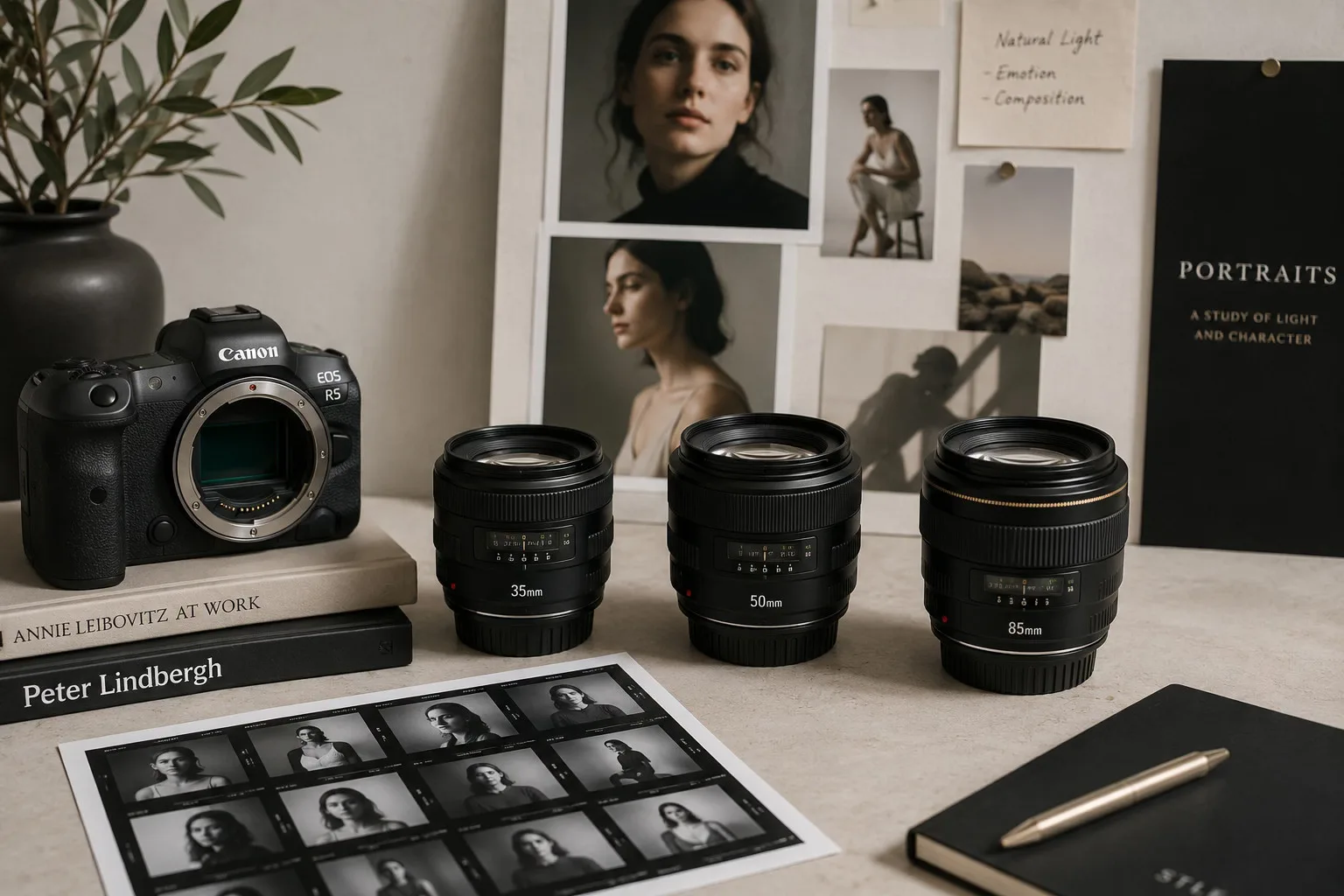
For many photographers, it starts with sharpness, aperture, brand, price, autofocus speed, or how “creamy” the background looks. Those things matter, but they are only part of the decision.
A lens also changes how close you stand to the model. It changes how much of the location enters the image. It changes the model’s comfort, the way the face is rendered, the amount of background compression, and the feeling of the final photo.
A 35mm, 50mm and 85mm can all create strong portraits.
They simply create different kinds of portraits.
The short answer
There is no single best lens for model photography.
A 35mm works well when the environment matters. It gives space to the location, styling, movement and story.
A 50mm is the flexible middle ground. It feels natural, works in smaller spaces, and can cover half-body portraits, lifestyle images and simple studio work.
An 85mm gives the classic portrait look. It creates more separation, gives flattering distance, and is especially useful for headshots, beauty portraits and model portfolio images.
A 135mm can create a more compressed, editorial look, especially outdoors or in larger spaces.
Lens choice should follow the shoot, not the other way around.
Focal length changes the relationship with the model
A lens does not only change framing.
It changes distance.
With a 35mm lens, you often stand closer to the model. That can create intimacy and energy, but it can also feel intrusive if the model is inexperienced or if you use it too close to the face.
With an 85mm lens, you stand farther away. That distance can help the model feel less pressured, especially during headshots or beauty portraits.
A 50mm sits between those worlds.
This matters during real shoots. A nervous model may relax more when the photographer is not standing too close. A confident model may enjoy the immediacy of a wider lens. A fashion editorial may need space for movement, while a beauty portrait may need more distance and compression.
Photographers often talk about “lens compression,” but the practical point is simpler: your shooting distance changes how facial features and background relationships appear. Longer portrait focal lengths often allow a more flattering working distance for faces, while wider lenses used close to the face can exaggerate features. Sony’s portrait lens guidance describes the 85mm as a classic portrait option because it offers subject isolation and flattering facial compression, especially when the photographer has enough room to move.
35mm: best for storytelling and environmental portraits
A 35mm lens is useful when the model is part of a larger scene.
It works well for:
lifestyle shoots fashion editorials with location full-body portraits street-style photography backstage images creator content model-on-tour stories small spaces where you cannot step back
The strength of 35mm is context.
You can show the room, street, outfit, movement and atmosphere. The image feels less isolated and more connected to a place.
That makes 35mm especially strong for FindAShoot-style content, where the story often includes more than a face: the city, the creative team, the moodboard, the styling, the process.
The risk is distortion.
A 35mm used too close to the face can make features look less flattering. It can enlarge the nose, stretch the edges of the frame, or make hands and feet look bigger if they are near the camera.
Use 35mm when the location matters. Be careful when framing tight headshots.
50mm: the flexible middle ground
A 50mm lens is often the first serious prime lens many photographers buy.
There is a reason for that.
It is usually affordable, compact, sharp, and easy to use. It gives a natural field of view without feeling extremely wide or extremely compressed. A 50mm can work for portraits, lifestyle images, small studio sessions and casual fashion work.
Sony Alpha Universe describes the 50mm as a solid middle ground portrait lens, especially useful in tighter spaces, while also listing 50mm primes among key portrait options for 2026.
The 50mm is good for:
half-body portraits simple studio images natural-light portraits lifestyle shoots small rooms beginner portfolio sessions full-body portraits when space is limited
It also teaches discipline.
A 50mm does not create the same instant flattering compression as an 85mm. It does not create as much environmental drama as a 35mm. It asks the photographer to work more carefully with distance, posing, lighting and background.
That can be useful.
A 50mm makes weak composition visible. It also rewards photographers who learn to direct properly.
For model photography, 50mm is often the practical choice when you need flexibility and only want to bring one lens.
85mm: the classic portrait lens
The 85mm is popular for a reason.
It gives distance, separation and a flattering portrait look without requiring the extreme working space of a 135mm or 200mm.
It works especially well for:
headshots beauty portraits model portfolio images upper-body portraits outdoor portraits clean studio work fashion portraits with background separation
Digital Photography School notes that 85mm is often a better choice for headshots because it allows tighter images from a more comfortable distance, while 50mm can put the photographer closer than many subjects prefer.
This matters on set.
An 85mm gives the model more breathing room. It lets the photographer frame the face without stepping into personal space. It also helps isolate the subject from the background, especially at wider apertures.
The downside is space.
In a small studio or apartment, 85mm can feel too tight. You may struggle to shoot full-body images unless you can step far enough back.
Use 85mm when the face, expression and separation matter. Avoid relying on it as your only lens if you often shoot in small rooms.
135mm: the editorial compression lens
A 135mm lens gives a more compressed, polished look.
It is especially strong outdoors or in large studios where you have room to move. The background appears closer and softer. The model separates strongly from the environment. The image often feels more premium, quiet and editorial.
Sony’s 2026 portrait lens list includes 135mm among its top portrait choices, alongside 85mm and 50mm options, which reflects how popular longer primes remain for portrait and fashion work.
A 135mm works well for:
outdoor fashion portraits compressed backgrounds elegant model tests editorial portraits full-body shots with distance images where the background should become soft and abstract
The tradeoff is communication.
You stand farther away from the model, which can make direction harder. In a busy location, that distance can also become impractical.
Use 135mm when you want elegance, separation and compression. Bring another lens if the shoot needs conversation, movement or tight spaces.
Zoom lenses: 24–70mm and 70–200mm
Prime lenses are popular because they are fast, simple and often beautiful.
Zoom lenses are useful because shoots change quickly.
A 24–70mm is practical for:
events BTS studio work full-body to half-body portraits quick framing changes mixed photo and video content
A 70–200mm is strong for:
outdoor portraits fashion runway-style coverage compressed backgrounds moments where you cannot move freely
Zooms are often heavier and more expensive, but they solve real problems. They help when the photographer has limited time, changing locations, or a team waiting on set.
Primes often create a more intentional rhythm. Zooms create speed.
Neither choice is automatically more professional.
What beginners often get wrong
Many beginner photographers expect the lens to create the whole portrait.
It will not.
A good portrait still depends on:
light distance posing styling expression background communication editing
An 85mm will not save weak direction. A 35mm will not make a boring location interesting by itself. A 50mm will not create intimacy if the model feels uncomfortable.
The lens influences the result. The photographer still has to build the image.
Beginners also forget sensor size.
On APS-C cameras, a 35mm behaves closer to a 50mm full-frame equivalent, and a 56mm behaves closer to an 85mm equivalent. Recent APS-C portrait lenses, such as the Viltrox 56mm f/1.2 Pro, are marketed as portrait primes partly because they offer that classic portrait field of view on crop-sensor systems.
This matters before buying.
A lens recommendation only makes sense when you know the camera system.
What models should know too
Models do not need to understand every technical detail, but lens choice affects how they appear.
A wide lens used too close can exaggerate features. A longer lens can make the face look more compressed and often more flattering. A 35mm may include more body language and location. An 85mm may focus more on expression and face.
This can also affect posing.
With 35mm, hands, feet and anything closer to the camera become more visually important. With 85mm, small changes in face angle and expression may matter more.
A model who understands this can collaborate better.
They can ask what kind of images the photographer wants to create: full-body lifestyle, beauty portraits, fashion editorial, clean digitals, or cinematic outdoor shots.
The lens is part of the mood.
Choosing the lens by shoot type
For a clean model portfolio, start with 50mm and 85mm.
For beauty portraits, choose 85mm or longer.
For fashion editorials with location, use 35mm, 50mm or 135mm depending on space.
For small studio portraits, 50mm is often easier than 85mm.
For outdoor cinematic portraits, 85mm and 135mm usually create stronger separation.
For BTS and creative team content, 35mm is practical because it captures people, space and process.
For video and mixed content, 35mm and 50mm often feel more flexible because they allow movement and communication.
Where FindAShoot fits in
Lens choice becomes easier when the shoot has a clear direction.
A photographer looking for a model for clean headshots may plan an 85mm setup. A model who wants lifestyle images may need someone comfortable with 35mm environmental portraits. A brand may need both: clean portraits and BTS content.
FindAShoot can help creatives define this before they meet.
Instead of planning a vague “let’s shoot,” photographers, models, MUAs, stylists and videographers can build a clearer concept around the final image style.
A lens is only one part of that plan.
The stronger the concept, the easier the technical choices become.
Final thoughts
The best lens for model photography depends on the image you want to create.
A 35mm brings the viewer into the scene. A 50mm keeps things flexible and natural. An 85mm gives the classic portrait look. A 135mm creates distance, compression and polish.
The lens changes more than the frame.
It changes the relationship between photographer, model, background and viewer.
That is why lens choice should start with a creative question:
How close should the viewer feel to the person in the image?
💬 Comments · 0 comments
Be the first to comment.