

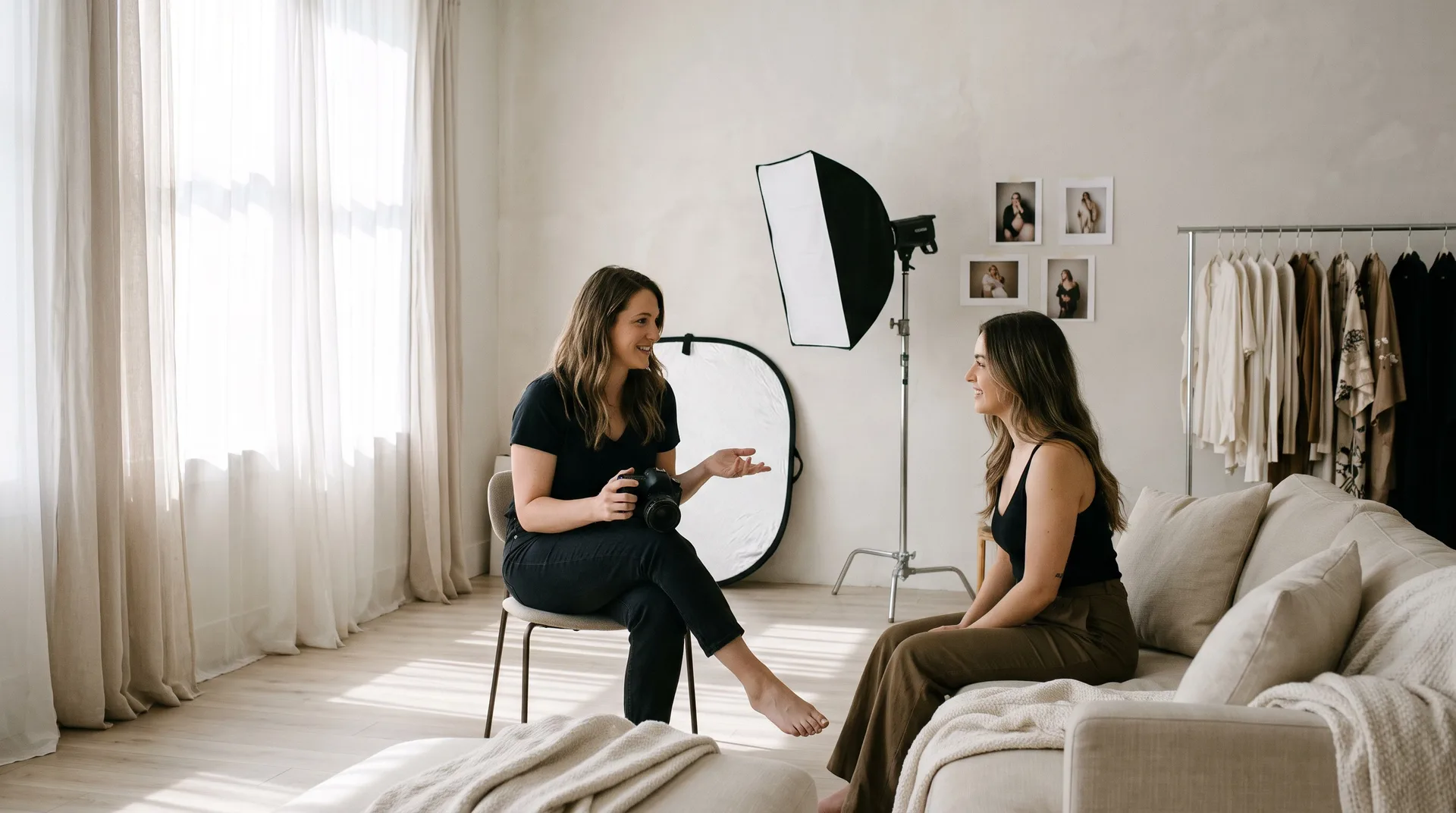
My career's first boudoir session began with a misunderstanding. The client had chosen a set with sheer lace; I had been looking forward to an elegant, suggestive aesthetic. Midway through the shooting, it hit me: she expected me to actively correct her poses—including ones that made me uncomfortable. I stood there, unsure, wishing we had talked more precisely beforehand about what we understood by "sensual."
Boudoir photography is about trust, intimacy, and showing people in their most vulnerable and at the same time strongest form. But it is precisely this closeness that makes clear boundaries so important. Without them, a creative process quickly turns into an uncomfortable situation—for both sides.
Why boundaries here are different from any other genre
In a portrait shooting, I might touch someone to straighten a collar. In boudoir, every touch, every instruction, every glance is charged with meaning. What would be harmless in another context can be experienced here as a violation—or at least radiate insecurity.
I remember a session in which the client suddenly hesitated when I suggested placing her hand on her hip. She nodded, but her body language said something else. I could have kept going, but I asked. She breathed a sigh of relief and explained that she felt uncomfortable because a previous photographer had been too direct. In that moment I realized: boundaries are not just protection, they are also the basis for real creativity. Only when everyone feels safe does space for experimentation emerge.
How to set boundaries without killing the mood
The key lies in communication—before the shooting begins. A thorough pre-consultation, ideally in person or via video, is worth its weight in gold. Talk about:
- Desired poses and styles: Show references, ask about her preferences. What is too daring? What is an absolute no-go?
- Touching: Explain how you usually give instructions—verbally or through gentle corrections. Offer to refrain from touching if she prefers that.
- Nudity and releases: Clarify beforehand what will be photographed and what will not. A contract that records usage rights and boundaries creates clarity.
During the shooting, the rule is: better to ask once too often than once too little. A simple "May I gently lift your shoulder?" shows respect and professionalism. And if you notice that a pose isn't working because the person is unsure, suggest something else. That preserves the atmosphere and shows that you are attuned to her signals.
The role of trust—and how to build it
Trust is not created through words but through actions. When you arrive, set up the room so the client feels comfortable: music she likes, a pleasant temperature, a protected area for changing. Show her the camera settings if she's interested, and explain what you're doing. That takes away the fear of the unknown.
Another point that is often underestimated: the follow-up. After the session, send the client a selection of unedited images so she can see that you respected her boundaries. Ask for feedback—not just on the result but also on the process. That shows that you care more about her well-being than about the perfect image.
What if it still becomes uncomfortable?
Sometimes, despite all caution, a situation arises that feels wrong. Perhaps the client crosses a boundary that you yourself did not communicate clearly. Or you notice that you feel uncomfortable because a pose becomes too intimate. In such moments, only one thing helps: being honest. "Let's pause for a moment—I want to make sure we both feel comfortable." That is not a sign of weakness but of strength.
I once had a client who suggested taking off her underwear entirely. I calmly explained to her that in my boudoir concept I do not photograph full nudity, and suggested an alternative. She was briefly disappointed but respected my boundary—and in the end, beautiful images emerged that she even liked better than the original idea. Boundaries are not there to restrict creativity but to steer it in a direction that feels right for everyone.
Staying professional means staying human
Ultimately, boudoir photography is not about perfection but about authenticity. If you know your own boundaries and communicate them openly, you create an atmosphere in which your clients can open up. That is the moment when real magic happens—and that is exactly why we do this job.
So: talk beforehand about everything that matters, listen during the session to your gut feeling and that of the other person, and don't be afraid to say no sometimes. That doesn't make you difficult; it makes you professional. And that is exactly what makes a boudoir session an unforgettable experience—for everyone involved.
💬 Comments · 0 comments
Be the first to comment.