

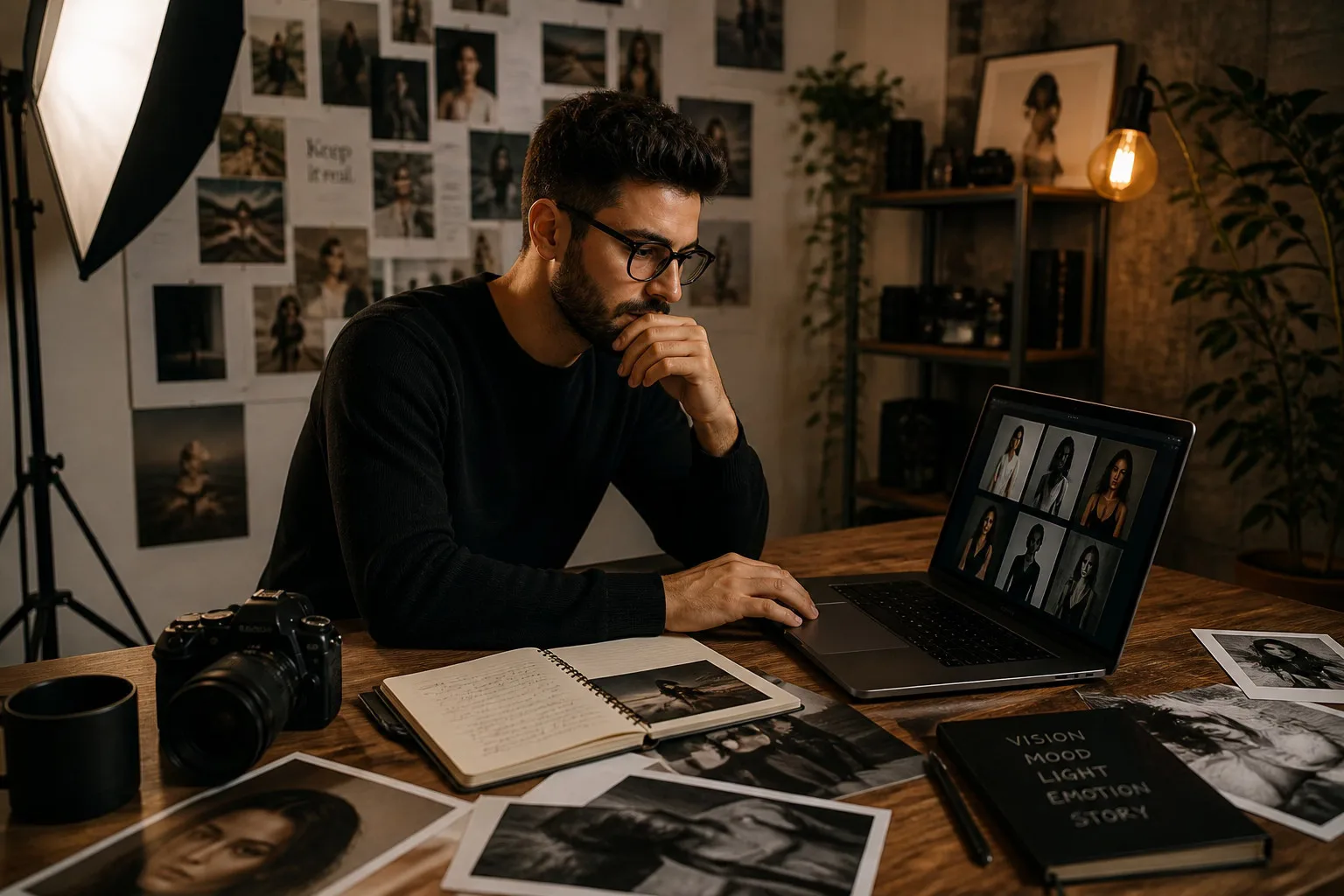
I remember the moment I stopped trying to imitate. I was editing a portrait, sliding the clarity and dehaze bars back and forth, chasing that crisp, cinematic look every third photographer on Instagram seemed to have mastered. The image looked good — technically clean, sharp, moody. But it didn't feel like mine. It felt like a borrowed voice.
That realisation stuck with me. Because a signature style isn't something you download or learn in a weekend workshop. It's not a preset pack or a particular colour grade. It's the visual equivalent of your handwriting — the way you naturally frame a glance, the light you're drawn to, the stories you choose to tell.
The Repetition That Reveals You
Nobody develops a style by shooting once a month. Style emerges from volume — from making so many images that your instincts start to override your influences. The first thousand frames are often just you figuring out what everyone else is doing. The next thousand are where you start to notice what you keep coming back to.
For me, it was a certain kind of quiet. I noticed that in my favourite shots, the subject was never looking directly at the camera. There was always a moment of pause, a slight turn of the head, a gaze aimed at something just out of frame. I hadn't planned it. It just kept happening.
That's the clue. Look at your own archive — not the portfolio, but the hard drive full of outtakes and experiments. What patterns appear? What do you keep doing without thinking? Those repetitions are the raw material of your style.
Constraints Over Chaos
Paradoxically, the fastest way to find your style is to limit yourself. Infinite possibilities lead to indecision and mimicry. Boundaries force you to get creative within a frame — and that's where personality shows up.
Try shooting with one lens for three months. Or only in natural light. Or only on black and white. Or only with available colour — no props, no styling. These limitations strip away the crutches and leave you with your core instincts: how you compose, what you emphasise, what you leave out.
I once spent a summer shooting only at golden hour, with a single 50mm lens, and only candid portraits of strangers. By August, I could feel my eye changing. I started to anticipate light, to see the geometry in a random street corner, to wait for the exact second when someone's expression shifted from posed to real. That summer's work still feels more like me than anything I've done since.
The Influence Trap
It's natural to be inspired by other photographers. We all have heroes. But there's a fine line between learning from them and copying them. The difference is intention.
When you study a photographer you admire, ask yourself: What is it that moves me? The use of shadow? The emotional distance? The texture? Then take that feeling and try to express it in your own way, with your own subjects, in your own environment.
I love the work of Peter Lindbergh — the raw, unretouched honesty. But I don't shoot in black and white on a desert dune. Instead, I try to bring that same honesty into my colour work, into the way I let my subjects be imperfect, into the quiet moments I choose to capture. That's the translation. That's how influence becomes yours.
Let Your Subjects Teach You
Style isn't just about technique. It's also about how you relate to the people in front of your camera. The way you direct, the atmosphere you create, the kind of vulnerability you invite — that's part of your signature too.
Some photographers are natural directors, orchestrating every gesture. Others are observers, almost invisible, waiting for something real to happen. Neither is better. But knowing which one you are — and leaning into it — makes your work recognisable.
I've learned that I'm not a great director. I fumble with posing instructions. But I'm good at making people forget I'm there. So I set up situations where I can be a quiet presence — a long walk, a conversation, a shared coffee — and then I just wait. The images that come out of that space feel truer to me than any carefully arranged shot.
The Edit That Defines You
Style isn't just in the capture. It's in the edit. The way you treat colour, contrast, grain — these choices become part of your visual signature. But here's the thing: your editing style should emerge from your shooting style, not the other way around.
If you shoot with soft, flat light, don't try to force a high-contrast, desaturated look in post. It will fight against the image. Instead, let your editing enhance what's already there. Find the adjustments that make your images feel more like the moment you remember, not like a trend.
I edit for warmth. Not in temperature — in feeling. I pull down the highlights, lift the shadows just slightly, add a touch of grain that feels like memory. It's subtle. Most people wouldn't notice. But it's the layer that makes the image feel like mine.
Be Patient
Style doesn't arrive fully formed. It evolves. The work you make today will look different from the work you make next year — and that's a good thing. The goal isn't to lock yourself into a formula. It's to develop a visual language that can grow with you.
Every now and then, look back at your old work. Not to cringe, but to see the thread. The thing that was already there, waiting for you to notice.
That thread is your signature. Pull it gently, and see where it leads.
💬 Comments · 0 comments
Be the first to comment.