

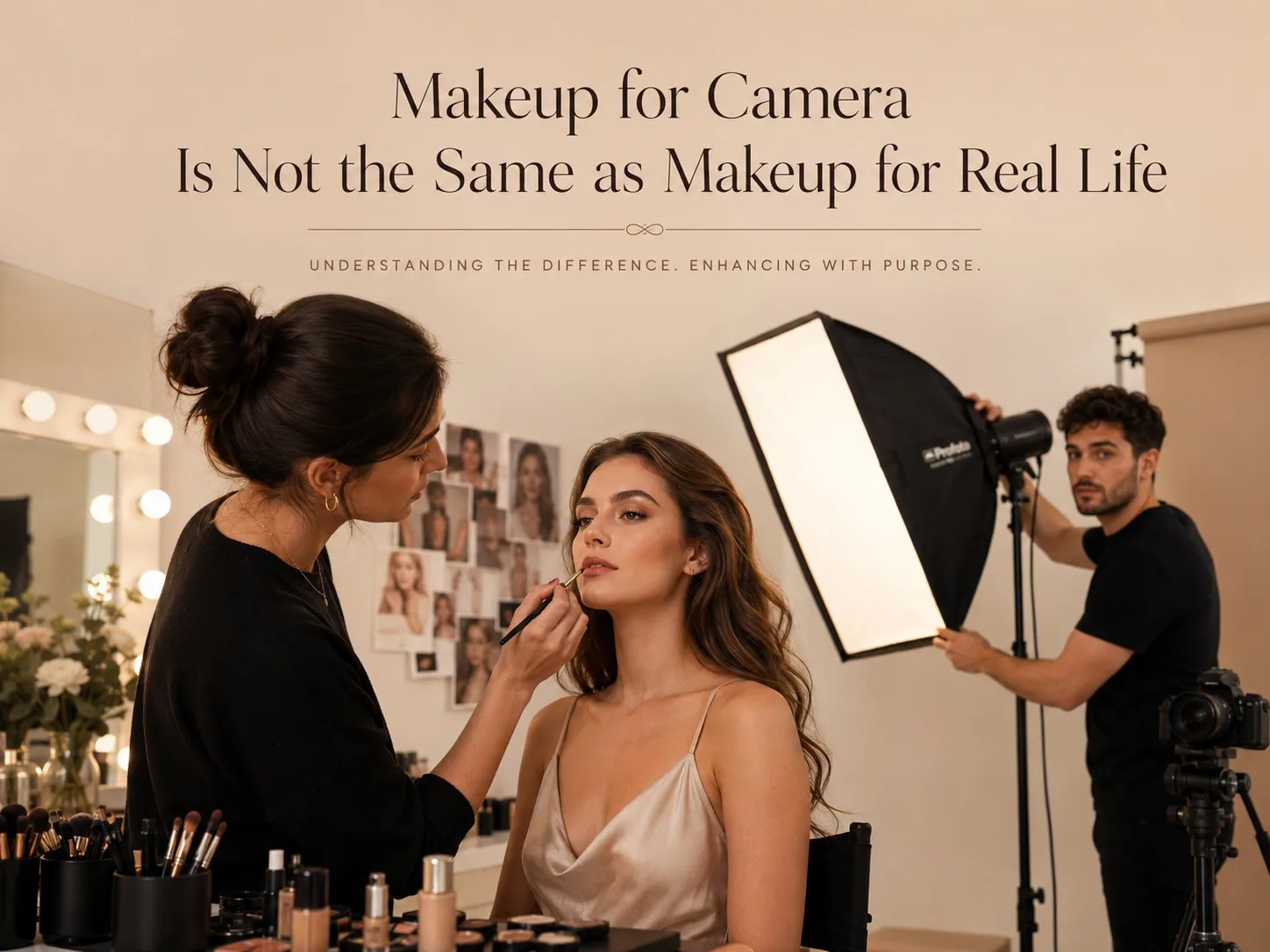
There is a small moment that happens on many photoshoots.
The model looks in the mirror and everything seems right. The skin is glowing. The blush feels soft. The lips are balanced. The makeup looks natural, fresh, and exactly enough.
Then the first test photo appears on the camera.
Something changed.
The blush almost disappeared.
The skin looks flatter than expected.
The under-eye area suddenly looks too bright.
A highlight that looked beautiful in the mirror now looks slightly oily.
A foundation that felt smooth in person suddenly shows texture under the light.
This does not always mean the makeup is wrong.
It means the camera is not the mirror.
Makeup for real life and makeup for photography are connected, but they are not the same thing. One is made for movement, distance, changing expressions, and human perception. The other has to survive light, lenses, flash, resolution, editing, and a frozen moment.
And that changes everything.
The Camera Does Not See Like the Human Eye
In real life, people see the whole person.
They see movement, warmth, expression, personality, voice, body language. Makeup is only one part of that impression.
A camera is less forgiving.
It freezes one fraction of a second and turns it into something that can be examined closely. Skin texture becomes more visible. Shine becomes more obvious. Color can shift depending on the light. Shadows can either sculpt the face beautifully or make it look tired.
This is why makeup that feels balanced in real life can look different in photos.
A softbox may make skin look smoother, but it can also flatten the face. Flash can reduce subtle color. A high-resolution camera can reveal texture that nobody would notice in normal conversation.
So the goal of camera makeup is not simply to make someone “look good.”
The goal is to help the makeup survive the photographic process.
Photoshoot Makeup Is About Structure
Good makeup for camera gives the face structure.
Not necessarily heavy contour. Not an Instagram mask. Not something that feels uncomfortable in person.
But enough shape that the face still has dimension once the light hits it.
This is especially important with:
- blush
- bronzer
- soft contour
- eye definition
- lip shape
- controlled highlights
A face naturally has depth. Studio light can soften that depth. If the makeup is too minimal, the final image may look flat, even if the person looked beautiful in the room.
This is why many makeup artists apply slightly more definition than someone might wear on a normal day.
Not because the final image should look “made up.”
But because the camera often eats subtlety.
Light Changes the Makeup
The same makeup can look completely different depending on the lighting.
Natural window light may make skin look fresh and soft.
Hard flash may emphasize texture.
Warm indoor light can make foundation look more yellow.
Cool LED lighting can make the skin appear slightly grey or tired.
Mixed lighting can make everything harder to correct later.
This is why makeup artists and photographers should talk before the shoot.
A beauty portrait with flash is not the same as a soft lifestyle session in window light. A clean commercial headshot is not the same as a cinematic editorial setup. Each lighting situation changes how the makeup should be prepared.
This is also where product choice matters.
Some products can create flashback, especially certain SPF or powder formulas. A Practical Wedding’s flashback testing notes that SPF is usually more problematic with flash photography than with outdoor daylight photos, while other photography-focused makeup resources warn that ingredients such as titanium dioxide, zinc oxide, and some silica-heavy powders can reflect light strongly under flash. :contentReference[oaicite:0]{index=0}
In simple terms:
Makeup should be tested under the light it will actually be photographed in.
A mirror alone is not enough.
The “Natural” Look Is Not Always Simple
One of the biggest beauty trends right now is skin that still looks like skin.
Luminous complexions, soft blush, bronzed warmth, blurred lips, and a more effortless finish are everywhere. Vogue Arabia describes 2026 makeup as moving toward luminous skin, soft blush, minimal eye makeup, and richer lip tones, while other 2026 beauty reports point to glow skin, skinimalism, blurred lips, soft cheeks, bronzed finishes, and “expensive skin.” :contentReference[oaicite:1]{index=1}
That looks easy.
But on camera, “natural” is often one of the hardest looks to create.
Because natural makeup has to be controlled without looking controlled.
Too much powder can look dry.
Too much glow can look greasy.
Too little blush can disappear.
Too little eye definition can make the face look tired.
Too much foundation can look heavy under close-up lighting.
This is the paradox of natural beauty photography:
The makeup may look effortless, but the planning is not.
Recommended Makeup Styles for Photoshoots
Not every shoot needs the same makeup style.
A good makeup direction depends on the concept, lighting, styling, model, and final use of the images. But some styles work especially well for camera because they balance beauty, structure, and flexibility.
1. Soft Editorial Glow
This is probably one of the most useful looks for modern portrait and fashion photography.
It works well for:
- model portfolio images
- beauty portraits
- lifestyle editorials
- clean studio shoots
- FindAShoot profile images
The idea is luminous skin, but not uncontrolled shine.
The skin should look alive, hydrated, and dimensional. The glow should sit intentionally on the high points of the face: cheekbones, bridge of the nose, inner eye, maybe a touch above the lip.
The danger is going too dewy.
What looks fresh in person can become oily under flash or strong continuous light. For camera, this look usually needs strategic powdering around the forehead, nose, and under-eyes, while keeping glow only where it helps the face.
Best with:
- softbox lighting
- natural window light
- warm editorial tones
- simple styling
Avoid:
- too much highlighter texture
- very reflective SPF products under flash
- heavy shimmer on textured skin
2. Clean Skin + Soft Sculpt
This is one of the safest and most professional photoshoot makeup styles.
It does not scream “makeup.”
It simply makes the face read better on camera.
The base is clean, but not flat. The face has soft sculpting around cheekbones, jawline, and temples. Blush gives life. Brows are groomed but not overdrawn. Lips are softly defined.
This works especially well when the goal is to make the model look polished but still real.
It is also very useful for:
- agency-style digitals with a slightly elevated finish
- personal branding portraits
- commercial castings
- natural studio portraits
For this look, balance matters more than drama.
The makeup should support the face, not become the subject.
Best with:
- simple backgrounds
- neutral outfits
- clean lighting
- minimal retouching
Avoid:
- harsh contour lines
- overly matte skin
- heavy brow blocks
- foundation that does not match neck and chest
3. Bronzed, Sun-Kissed Beauty
This style is very current and camera-friendly when done carefully.
Recent beauty coverage has highlighted “Aussie Girl Glam” as a sun-kissed, bronzed, effortless aesthetic with breathable skin, warm bronzer, blush across the cheeks and nose, soft lips, and a lived-in feeling. :contentReference[oaicite:2]{index=2}
This kind of look can be beautiful for:
- summer shoots
- beach-inspired editorials
- travel model content
- outdoor golden-hour portraits
- natural fashion campaigns
The key is warmth without turning orange.
Bronzer should connect naturally with the skin tone. Blush can be slightly higher and softer, sometimes crossing the nose for that sun-touched feeling. Lips usually work best when they are defined but not too perfect.
Best with:
- golden hour light
- warm color grading
- linen, denim, swimwear, or relaxed styling
- outdoor or travel concepts
Avoid:
- bronzer that is too red or muddy
- foundation that does not match the body
- too much shimmer under direct sun
- overdoing faux freckles if the concept does not need them
4. Matte Soft Glam for Flash
Flash photography changes everything.
A dewy look can become too shiny. A subtle blush can disappear. Powder can either save the image or ruin it if it creates flashback.
For flash, a slightly more controlled finish often works better.
This does not mean flat matte skin. It means controlled skin.
The T-zone should usually be managed. The under-eye area should be bright but not reflective. Contour and blush need to be visible enough to survive the flash. Lips and eyes can carry more structure than in natural daylight.
This look works well for:
- studio flash portraits
- fashion tests
- evening editorials
- high-contrast beauty images
Best with:
- flash or strobe lighting
- controlled studio environment
- stronger styling
- clean backgrounds
Avoid:
- SPF-heavy base products
- reflective powders
- very oily highlighters
- foundation that oxidizes under strong light
5. Bold Lip, Minimal Eye
This is a simple but very effective editorial direction.
A strong lip can carry an entire image.
Vogue’s 2026 trend coverage points toward richer brown lips, dark chocolate tones, burnt caramel, espresso, and also the return of bright rose and pink lip moments in spring beauty reporting. :contentReference[oaicite:3]{index=3}
For photoshoots, this works especially well when everything else is restrained.
Clean skin.
Soft eye definition.
Natural brows.
Simple hair.
Strong lip.
This creates focus.
It also photographs well because the viewer immediately knows where to look.
Best with:
- close-up portraits
- beauty editorials
- simple styling
- minimal backgrounds
Avoid:
- too many competing elements
- strong eye + strong lip unless the concept is intentionally dramatic
- dry lip texture
- uneven lip line in close-up beauty shots
6. Graphic Eye or Creative Detail
Not every shoot needs natural beauty.
Sometimes one strong creative element makes the whole image.
A graphic liner, metallic eye, colored mascara, glossy lid, unusual brow, sculptural hair, or monochrome color story can create editorial impact. Recent runway and beauty coverage continues to highlight more artistic approaches to beauty, from sculptural hair to dramatic eye looks and monochrome color moments. :contentReference[oaicite:4]{index=4}
But this kind of makeup needs a clear concept.
If the styling, lighting, and posing are not aligned, graphic makeup can look random instead of intentional.
Best with:
- editorial shoots
- fashion concepts
- strong moodboards
- experienced models
- careful lighting
Avoid:
- adding a creative element without a reason
- mixing too many colors
- letting the makeup compete with styling
- weak lighting that hides the detail
Makeup for Camera Needs Skin Prep
Good makeup starts before foundation.
Skin prep matters because the camera sees texture, dryness, oil, and uneven application more clearly than people expect.
A basic camera-ready routine usually includes:
- gentle cleansing
- light exfoliation if needed
- hydration
- primer suited to the skin type
- enough time for products to settle
Photoshoot makeup guides often emphasize skin prep as one of the key steps for long-lasting, smoother makeup on camera. :contentReference[oaicite:5]{index=5}
But there is a balance.
Too much skincare right before makeup can create slipping. Too little can make foundation cling to dry areas.
The makeup artist’s job is not only to apply color.
It is to understand the surface.
Makeup, Styling, and Editing Need to Speak the Same Language
Makeup does not exist alone.
A soft bronze look may feel strange with cold futuristic styling.
A bold lip may lose impact if the outfit is too loud.
A glossy skin look may be difficult if the retouching style is very matte.
A natural face may feel unfinished if the lighting is dramatic and contrast-heavy.
This is why moodboards matter.
Not because every detail needs to be copied.
But because everyone needs to understand the same direction.
The photographer thinks in light.
The makeup artist thinks in texture and color.
The stylist thinks in shape and fabric.
The model feels the look physically.
The retoucher sees what survives after the camera.
When these roles are aligned, the final image feels intentional.
When they are not, something feels slightly off — even if each person did their job well.
The Photographer Also Has Responsibility
Makeup problems are not always makeup problems.
Sometimes the light is wrong.
A foundation may look strange because color temperatures are mixed. A highlight may look excessive because the light is too direct. Texture may look harsh because the light angle is unforgiving.
The photographer should not treat makeup as something separate from lighting.
Before the shoot, it helps to clarify:
- natural light or flash?
- soft beauty light or hard editorial light?
- warm color grading or neutral tones?
- heavy retouching or natural skin texture?
- close-up beauty or full-body fashion?
Those questions change the makeup decisions.
And they make the whole team calmer.
The Makeup Artist Protects the Image
A good makeup artist does more than prepare the model.
They protect the image during the shoot.
They notice shine before it becomes a problem.
They check whether blush still reads on camera.
They adjust lips after outfit changes.
They understand when powder is needed and when it would kill the glow.
This work is often invisible.
If it is done well, nobody says, “What good touch-ups.”
They simply see a strong image.
That is the strange beauty of good makeup work: it often disappears into the final result.
Find the Right Creative Team
This is why photoshoots are never really just about one person.
A strong image may begin with a photographer’s idea or a model’s presence, but the final result is usually shaped by a team.
Photographer.
Model.
Makeup artist.
Stylist.
Retoucher.
Each person affects the final image.
And sometimes the missing piece is not a better camera, a better lens, or more editing.
Sometimes the missing piece is the right makeup artist.
Platforms like FindAShoot can help creatives connect around the full production, not just one role. Because building a strong shoot is often less about finding “someone available” and more about finding the right people for the visual direction.
Final Thoughts
Makeup for camera is not about wearing more makeup.
It is about understanding what the camera changes.
Light changes color.
Flash changes contrast.
Lenses change perception.
Editing changes texture.
And the final image depends on how all of those pieces work together.
Real-life makeup is made for movement and presence.
Camera makeup is made for a frozen moment.
Both can be beautiful.
But they are not the same.
💬 Comments · 0 comments
Be the first to comment.