

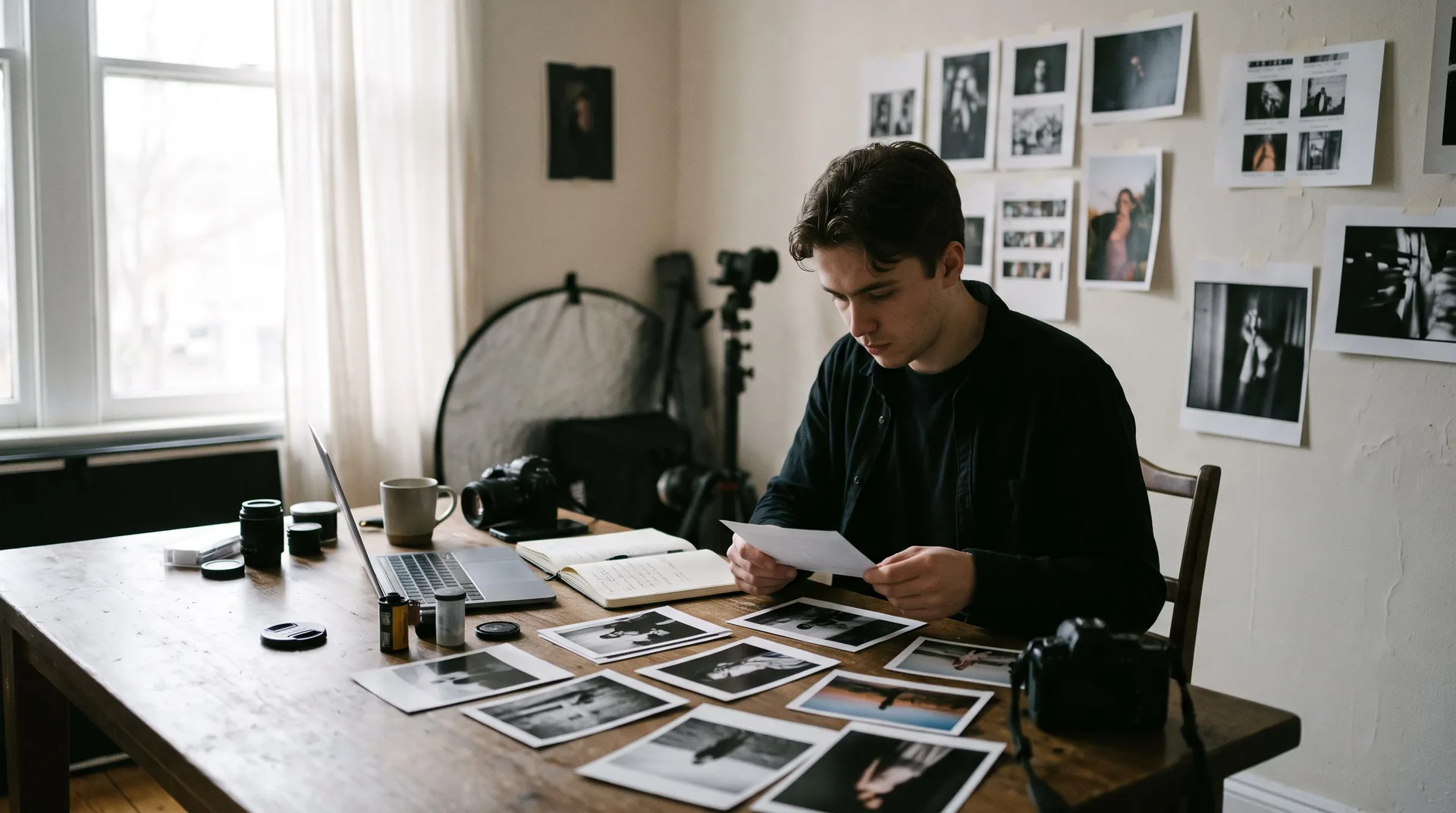
The first impression counts – but it doesn't have to be perfect
You have the camera in your hand, the light is right, the model is ready. And then comes the moment when you realize: this is going to be your first image for your portfolio. It's a good feeling – and at the same time an oppressive one. Because somehow this image is supposed to show everything you can do. Only: what can you actually do?
Anyone starting out in photography faces a paradoxical problem: you need commissions to have a portfolio, and a portfolio to get commissions. The solution is not to wait for the perfect first client. It is to become active yourself – with what you have, and with what you want to learn.
Honesty instead of perfection
A common mistake at the beginning is to fill the portfolio with work that you believe is "good enough." In doing so, you forget that a portfolio is not an application folder in which you cram as much as possible. It is a visual business card that shows what you're working on – and how you think.
For career starters, that means: don't just show the results, but also the direction. If you're interested in natural light, then show images that express exactly that. If you love fashion, then curate your selection so that this passion comes through – even if not every image is perfect. A portfolio that is honest feels more authentic than one that tries to please everyone.
I remember a conversation with an art director who once told me: "I'd rather hire someone who has three strong images and knows what they want than someone with thirty mediocre works." That left a lasting impression on me. Quality over quantity is not a cliché – it's a survival strategy.
Projects instead of commissions
The good news: you don't have to wait for commissions to fill your portfolio. You can start your own projects. That sounds like a lot of work, but it's often the most direct way to show what you can do. A personal project has the advantage that you have control over everything – from concept to execution. You decide which story you tell, and you can focus on what really interests you.
An example: if you're passionate about portrait photography, find friends or acquaintances who enjoy being in front of the camera and develop a small series together with them. Perhaps with a theme that's close to your heart – such as people in their work environment or in their favorite place. Such projects often have more depth than a single shooting because they tell a story. And that's exactly what clients want to see later: that you're capable of realizing an idea.
Spoiled for choice: what belongs in it?
At some point the selection is there. You have enough images to fill a portfolio – but which ones do you choose? The temptation is great to show everything that looks somehow good. But less is often more. A good guideline is to limit yourself to 10 to 15 images. That forces you to be strict and show only what is truly strong.
Pay attention not only to the individual images but also to the overall impression. How does the selection work as a whole? Is there a common thread? Does it show a development, or does it feel thrown together? A portfolio should be like a small album that tells a story – your story. That's why it's also important that the images fit together. That doesn't mean they all have to look the same, but they should speak a common language.
Dealing with criticism
A portfolio is never finished. It grows with you, with your skills, and with your experiences. That's why you should also revise it regularly. Show it to people whose opinion you value – other photographers, art directors, perhaps clients too. And then: listen. Not every piece of criticism is right, but often there's a kernel of truth in it.
I once removed an image from my portfolio because someone told me it was "too tame." At first I was offended – but he was right. It was technically clean, but it lacked tension. I replaced it with another that showed more risk. And that very image later brought in a commission. Criticism is not an attack on you as a person, but an offer to grow.
The moment when it counts
In the end, the portfolio is your door opener. It's the first thing a potential client sees, and it decides whether they contact you at all. That's why you shouldn't neglect it. But don't forget: it's also a living document. It may change, just as you change. And it's completely fine if not everything is perfect. Perfection is not the goal – expression is.
So the next time you sit in front of your screen wondering which images to show, remember: it's not about showing everything you can do. It's about showing who you are.
💬 Comments · 0 comments
Be the first to comment.