

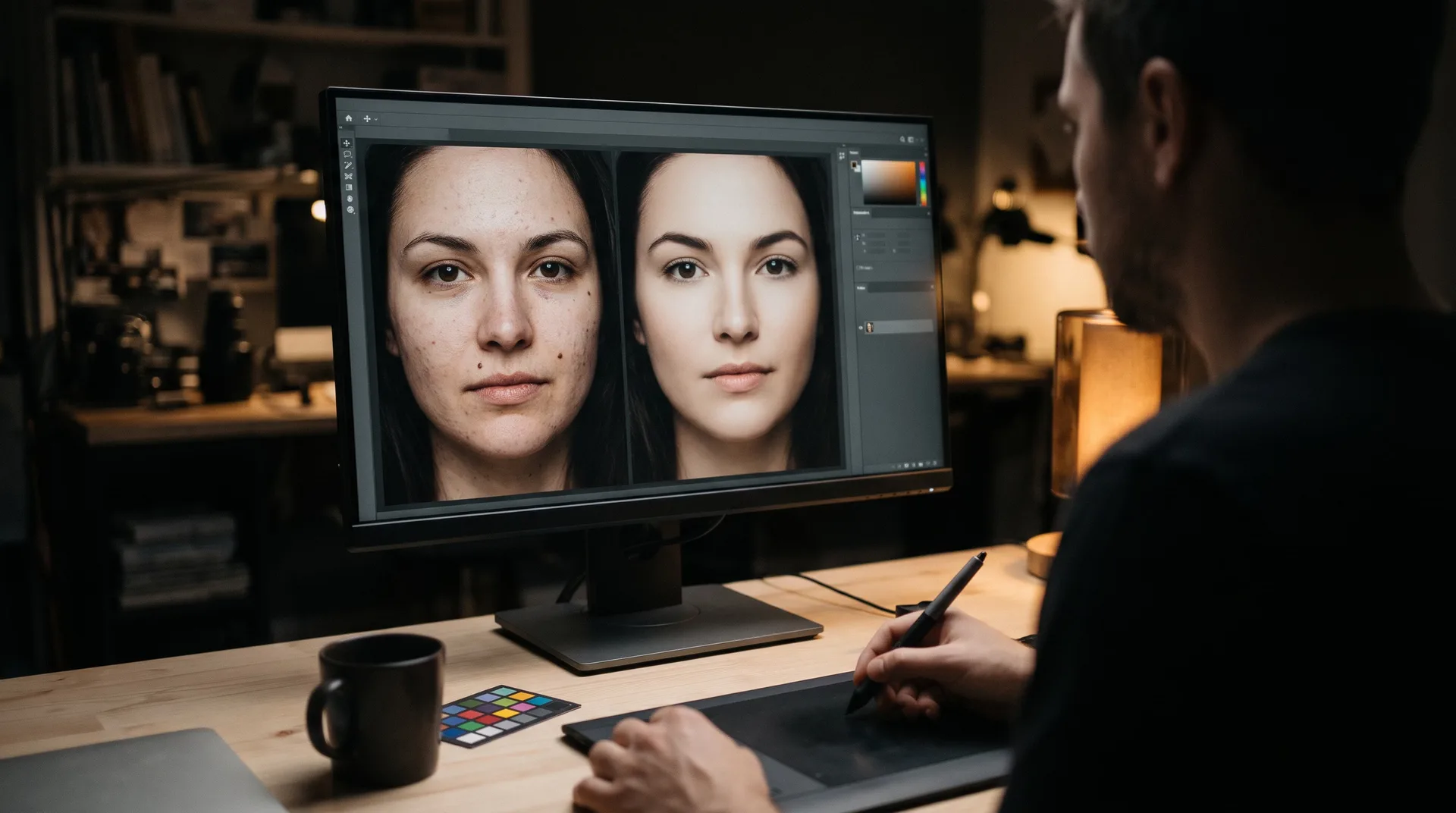
The Unspoken Dilemma
It's Tuesday evening, and I'm sitting in front of a perfect portrait. The skin is flawless, the eyes are bright, the composition is right. And yet I hesitate with the brush. The question that has accompanied me for years resurfaces: When is enough? We all know the feeling when a shot is actually already finished, but we still smooth out a wrinkle or increase the contrast. But where exactly is the line between tasteful optimization and a distortion that the person no longer recognizes themselves in?
In the photography community, this is rarely discussed openly, even though it affects all of us – models, photographers, make-up artists, and above all the retouchers who work quietly in the background. Everyone has a different idea of what "natural" means. And these differences not infrequently lead to conflicts that could be avoided.
The Perspective of Those Involved
A model who looks at the edited images after a shooting expects a version of themselves that they perhaps don't see in the mirror – but one that still feels like them. I have encountered models who were annoyed by too much smoothing because they felt their personality had been retouched away. Others, in turn, were disappointed when I left a wrinkle or a pimple in place.
Photographers, on the other hand, often have a specific look in mind that fits the brand or the project. They sometimes push for stronger editing in order to convey a certain feeling – for instance, a flawless advertising aesthetic. Brands, in turn, frequently demand an absolutely smooth, almost unnaturally pure presentation, especially in the fashion or beauty industry. The pressure comes from above, and retouching is the last link in the chain.
"I don't retouch to change people. I retouch to complete the image that the photographer saw – before the noise and the imperfections of technology got in the way." – A retoucher friend
Practical Boundaries – and How to Find Them
So how do you find the golden mean? A good first step is an honest conversation before the shooting. Ask the model directly: "What matters to you when it comes to editing? Are there things you absolutely don't want changed?" Many models today have a clear awareness of their body and their skin – they know what they want to show.
A rule of thumb that an experienced colleague gave me: "Anything that disappears again within 24 hours can go – a pimple, a swelling, a hair that distracts in the light. Anything that belongs to the face – a scar, a mole, the shape of the nose – stays, unless the model explicitly asks for a change."
That sounds simple, but in practice it is often difficult to implement. Because some skin blemishes are chronic, and some wrinkles are an expression of joie de vivre. Here it helps to keep asking yourself: Would I make this edit if the model were standing next to me watching? If I hesitate, it's probably too much.
A Plea for More Transparency
What I often miss in the discussion is openness about one's own work. Many photographers and retouchers shy away from showing their editing steps – out of fear of appearing "fake." Yet that would be exactly the path to more trust. A brief note in the contract or in the conversation: "I will make light skin retouching and color corrections. I will discuss larger interventions with you beforehand." That gives the model security and prevents misunderstandings.
As a community, too, we can encourage each other to be more honest. Feel free to show a before-and-after that doesn't only show the perfect side, but also the small decisions in between. That demystifies retouching and makes it what it is: a craft tool, not a magic trick.
Less Is Often More
At the end of the day – no, I wanted to avoid that sentence. Let's say: When I look at my own favorite images, they are rarely the ones with the strongest editing. They are the ones where I feel I can see the person behind them. A slight texture in the skin, an asymmetrical smile, a few freckles – those are the details that make an image alive. Retouching should not erase what makes us unique. It should polish the frame, not paint over the painting.
💬 Comments · 0 comments
Be the first to comment.