

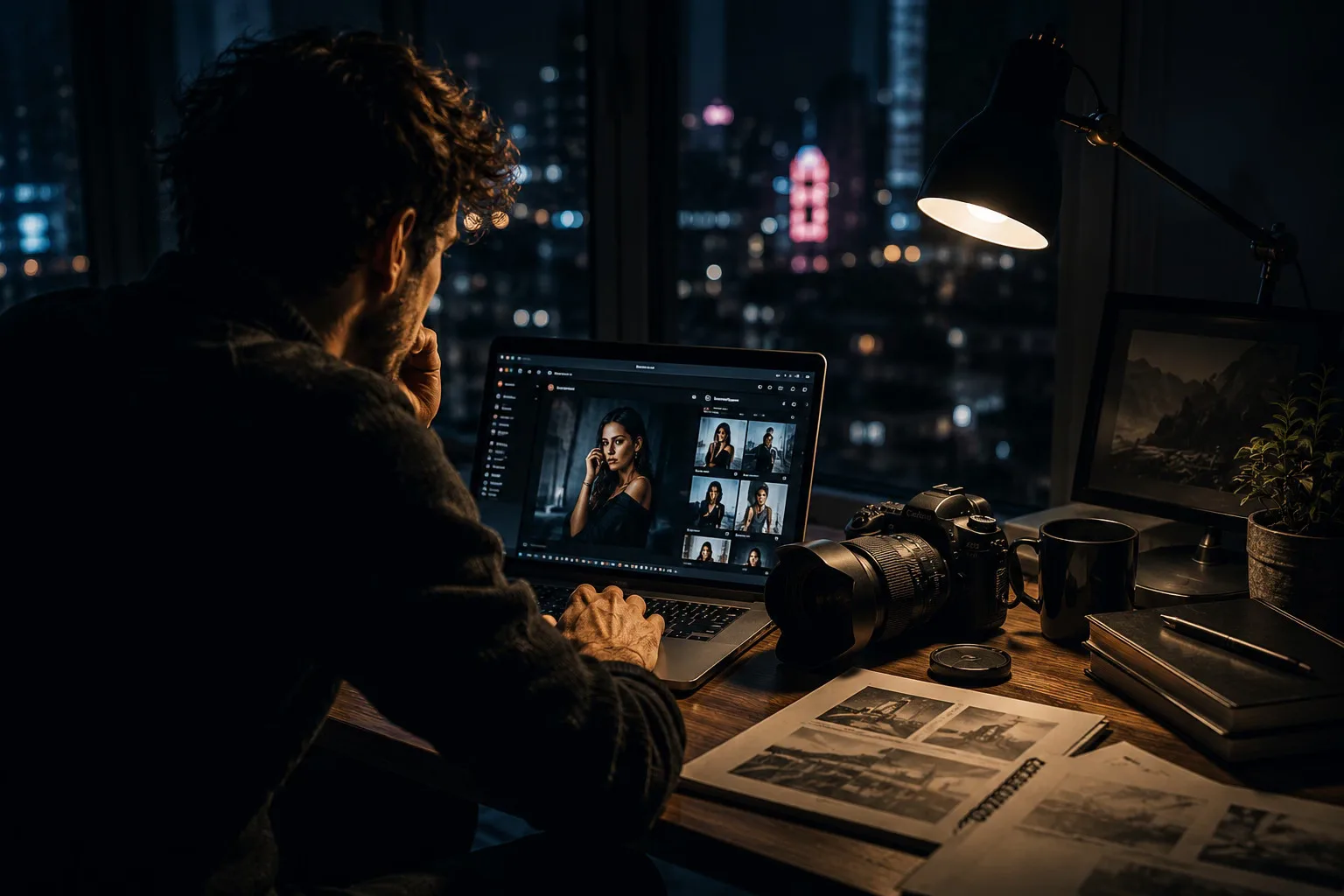
There was a time when photographs moved slower.
People printed them. Framed them. Kept them in boxes for years. A strong image stayed visible because it physically existed somewhere — on a wall, in a book, inside a family album.
Now most photographs live for a few seconds.
You post them. People scroll past them. The algorithm decides who sees them. By tomorrow, they are already buried under newer content.
And slowly, without fully realizing it, photography itself changed.
Not just how we share images.
How we create them.
How we evaluate them.
How we remember them.
And sometimes, even why we take them in the first place.
Photography Became Faster Than Ever
Before social media, photography often had distance built into it.
There was time between:
- shooting
- editing
- printing
- publishing
That distance created reflection.
Photographers sat longer with their work. Images developed more slowly, both technically and emotionally.
Social media removed most of that space.
Now a shoot can happen in the afternoon and appear online two hours later.
And because platforms reward consistency, photographers quietly adapted to a new rhythm:
keep posting.
Not always because they wanted to.
But because disappearing online started to feel dangerous.
The algorithm rewards activity. Visibility became tied to frequency. And over time, many creatives stopped creating only when inspiration existed.
They started creating because silence online feels like invisibility.
Instagram itself openly explained that engagement signals influence visibility distribution across the platform.
Source:
https://about.instagram.com/blog/announcements/shedding-more-light-on-how-instagram-works
That may sound technical, but creatively, the effect is enormous.
Because once creatives understand that certain images perform better, visual behavior begins changing around performance itself.
Images Started Competing for Interruption
Photography used to compete mostly on quality.
Now it competes on speed of attention.
Can the image stop someone from scrolling for two seconds?
That question changed visual culture more than most people realize.
Small screens changed aesthetics.
Images now need to work:
- instantly
- vertically
- while moving
- surrounded by distractions
And naturally, certain visual styles became more effective online:
- stronger contrast
- cleaner compositions
- brighter skin tones
- recognizable color grading
- immediate emotion
Even editing evolved around interruption.
Some images today are not optimized for storytelling.
They are optimized for stopping thumbs.
That does not automatically make them bad photographs.
But it does change the intention behind them.
The Feed Quietly Replaced the Portfolio
One of the biggest transformations social media created is this:
The portfolio disappeared into the feed.
Years ago, photographers built carefully selected portfolios.
Now most people are evaluated through endless scrolling grids.
And feeds behave differently than portfolios.
A feed rewards:
- consistency
- recognizable aesthetics
- repetition
- branding
- visual familiarity
This is one reason why so many creative profiles start looking strangely similar after a while.
The same tones.
The same poses.
The same editing.
The same locations.
The same facial expressions.
Not because creatives suddenly lost originality.
But because social media rewards familiarity much faster than experimentation.
Visibility Became Its Own Currency
One of the strangest things social media introduced is that attention itself became economically valuable.
Not metaphorically.
Literally.
Researchers and economists now refer to this ecosystem as the creator economy — a system where visibility, audience, and engagement generate real opportunities, influence, and income.
Source:
https://en.wikipedia.org/wiki/Creator_economy
This changed photography deeply.
Because now images are not only artistic objects.
They are also:
- marketing tools
- branding tools
- engagement tools
- networking tools
- social currency
Some shoots today are planned less around creativity — and more around performance.
People think about:
- what will repost well
- what will generate engagement
- what fits the algorithm
- what increases visibility
And over time, the line between photography and content creation became increasingly blurred.
The Emotional Relationship With Photography Changed Too
One of the biggest psychological shifts social media introduced is measurable public validation.
Before platforms like Instagram, photographers rarely received instant emotional feedback from thousands of people.
Now every image immediately receives numbers:
- likes
- saves
- shares
- comments
- reach
And those numbers quietly influence how creatives feel about their work.
A photographer can create an image they personally love… and still feel disappointed because it “underperformed.”
That emotional structure is new.
Research around creator mental health has repeatedly shown links between engagement pressure, anxiety, burnout, and self-worth becoming tied to online performance.
Source (Harvard T.H. Chan School of Public Health):
https://hsph.harvard.edu/news/content-creators-are-struggling-with-mental-health-study-finds/
Another study discussing stress and pressure among creators:
https://www.sciencedirect.com/science/article/pii/S2772503023000713
This does not mean social media is inherently harmful.
But it does mean photography is no longer emotionally separated from metrics.
And metrics change behavior.
We Started Photographing Ourselves Differently
Social media also changed how people see themselves.
Not just photographers.
Everyone.
People became more aware of:
- angles
- lighting
- symmetry
- poses
- visual identity
For many, photographs stopped being documentation.
They became presentation.
And presentation changes psychology.
People no longer only ask: “Do I like this photo?”
They ask: “How will this look online?”
That is a very different relationship with images.
The Strange Pressure to Stay Visible
One of the most exhausting parts of modern photography is that visibility feels temporary.
You can create strong work for years and still feel pressure to constantly remain active online.
Because attention resets quickly.
Yesterday’s viral image becomes irrelevant fast.
And this creates a subtle form of creative fatigue.
Photographers stop asking: “What do I actually want to create?”
Instead, many start asking: “What will still perform?”
That shift is quiet.
But once it happens, creativity starts becoming partially shaped by algorithms.
The Creatives Who Last the Longest
Interestingly, many creatives who survive long-term eventually separate their identity from the algorithm.
They still use social media.
But they stop allowing it to fully define:
- their confidence
- their artistic direction
- their sense of value
They understand the platform without emotionally depending on it.
And that balance matters.
Because trends move quickly.
Algorithms change constantly.
But personal vision usually develops slowly.
Final Thoughts
Social media did not just change photography.
It changed:
- how images are created
- how they are consumed
- how visibility works
- how creatives build careers
- how people see themselves
- how artistic value is measured
Some of those changes created incredible opportunities.
Others created new pressure that previous generations of photographers never experienced.
Most creatives today are navigating both realities at the same time.
And maybe that’s the biggest shift of all:
Photography is no longer only about creating images.
It is also about surviving inside an economy built around attention — where visibility moves faster than memory ever did.
💬 Comments · 0 comments
Be the first to comment.