

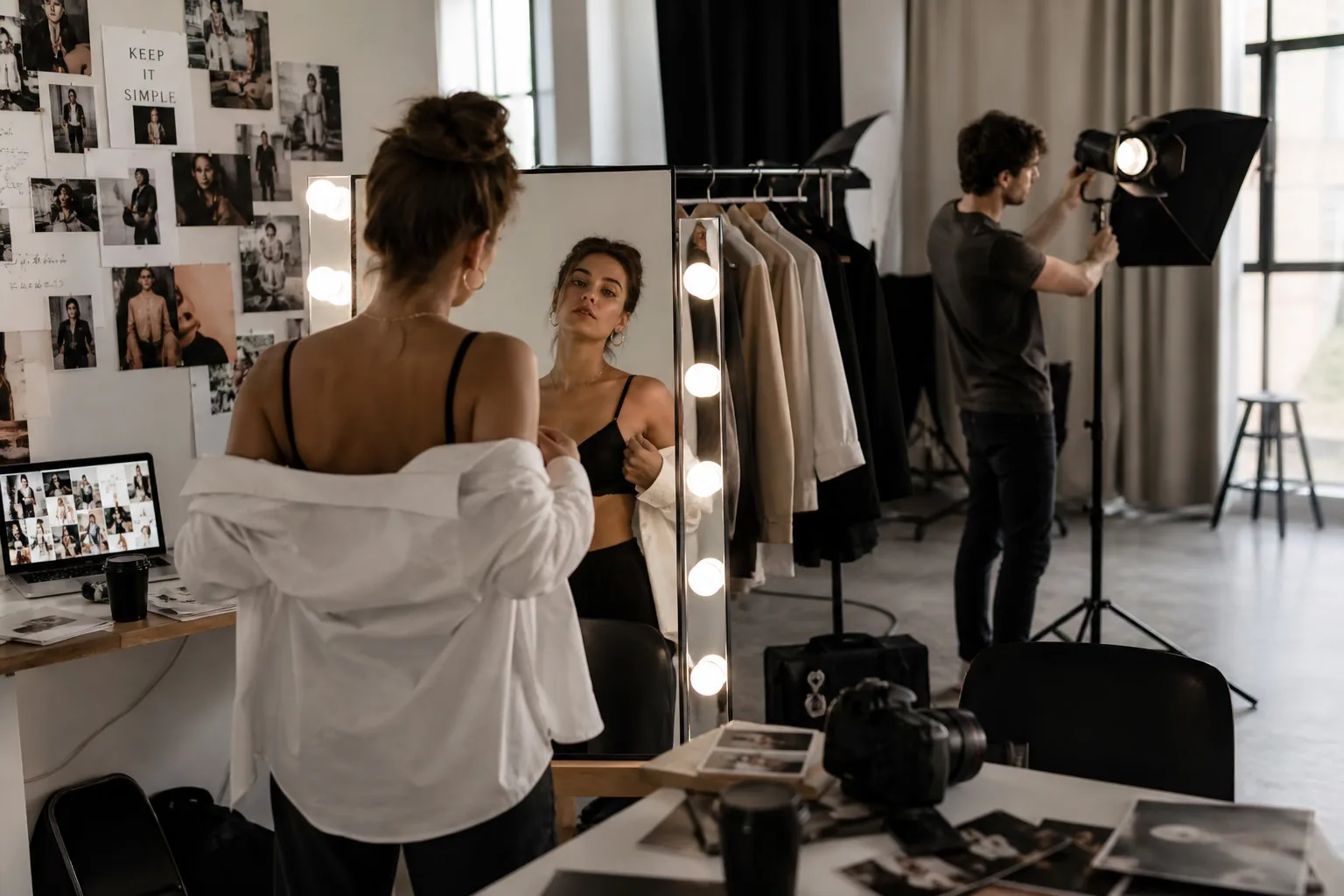
What I Wish I Knew Before My First Photoshoot
Your first photoshoot stays in your memory for a long time.
Not because everything goes perfectly.
Usually, it doesn’t.
You arrive with expectations.
You think you will know what to do.
You imagine standing in front of the camera, smiling naturally, maybe feeling confident after a few minutes.
Then reality starts.
You notice where your hands are.
You wonder if your posture looks awkward.
You suddenly become aware of your face in a way you never notice in everyday life.
For many people, the strange part is not the camera.
It is the feeling of being observed.
And that feeling can be surprisingly intense.
During a small studio session in Vienna, I once watched someone arrive looking very confident.
She had a strong moodboard, carefully chosen outfits, and clear ideas.
But once the lights turned on, she froze.
Not dramatically.
Just enough to make every pose look slightly tense.
Twenty minutes later, something changed.
The conversation became easier.
Music started playing.
The pressure disappeared.
And suddenly the photos looked natural.
That shift happens more often than people think.
The beginning of a photoshoot is usually the hardest part.
Not because you are doing something wrong.
But because your brain is adapting to something unfamiliar.
If you are preparing for your first shoot, there are a few things that would have helped to know earlier.
1. Understand the Purpose of the Shoot
Before anything else, ask yourself a simple question:
Why are you doing this photoshoot?
Every shoot has a different purpose, and that purpose influences styling, posing, mood, and preparation.
For example:
- Portfolio shoot for models
- Fashion editorial
- Personal branding
- Dating profile photography
- Lifestyle content
- Social media content
- Creative collaboration (TFP)
Knowing the purpose helps you avoid confusion later.
If you are working with a photographer, ask for clarity:
- What is the vision?
- What style are you aiming for?
- Are the images casual, fashion-focused, dramatic, minimal, or cinematic?
A good shoot becomes easier when everyone shares the same expectations.
2. Create a Moodboard
One of the easiest ways to reduce anxiety before a shoot is to create a moodboard.
A moodboard is not just a collection of pretty images.
It becomes a visual language between you and the photographer.
Many first-time models arrive without references and say things like:
“I just want something cool.”
The problem is that “cool” means something different to everyone.
One person imagines soft lifestyle photos.
Another imagines dramatic editorial lighting.
A moodboard removes guesswork.
Pinterest works extremely well for this.
Save references that reflect:
- Posing style
- Outfit ideas
- Facial expressions
- Lighting mood
- Makeup style
- Overall atmosphere
You do not need hundreds of images.
In fact, too many references can become confusing.
Ten strong images are usually enough.
Photographers appreciate moodboards because they immediately understand your expectations.
And for beginners, having visual references often makes posing feel less intimidating.
You stop guessing.
You start understanding the mood you want to create.
3. Choose the Right Outfit
Clothing matters more than people think.
Not because expensive outfits automatically create better photos — but because what you wear changes how you feel.
During beginner shoots, uncomfortable clothing becomes obvious very quickly.
If something is too tight, constantly slipping, or needs adjustment every few minutes, it creates distraction.
You stop focusing on the shoot and start focusing on fixing your outfit.
Simple usually works best.
Neutral colors photograph well.
Clean textures are easier to style.
And clothes that fit naturally almost always look better than something chosen only because it is trendy.
Bring a few options if possible.
A photographer may notice that one outfit works better under certain lighting.
This happens often.
What looks great at home sometimes feels different once you see it in a studio environment.
A practical tip: bring one outfit that feels safe and comfortable.
When nerves appear, familiar clothing can help you relax faster.
4. Sleep Matters More Than You Think
Many people underestimate how much sleep affects photography.
A tired face appears in subtle ways:
- Puffy eyes
- Tension around the mouth
- Dull skin tone
- Lower confidence
- Less natural expressions
Try to sleep well the night before.
Hydration also helps.
Drink enough water in the 24 hours before your shoot.
Healthy skin almost always photographs better than skin hidden behind heavy editing.
5. Do Not Overdo Makeup
This is especially important for first-time models.
Heavy makeup can sometimes create the opposite effect of what people expect.
Strong makeup may:
- Hide natural facial structure
- Look unnatural in daylight
- Become harder to retouch
- Clash with lighting styles
For most beginner shoots, clean and natural makeup works best.
The camera often captures details differently than mirrors do.
If a makeup artist is involved, communicate the moodboard in advance.
This avoids misunderstandings and creates a more polished result.
6. Practice Basic Poses Before the Shoot
One of the biggest myths about photography is that posing comes naturally.
For most people, it does not.
Even experienced models still warm up during the first minutes of a shoot.
You do not need to memorize complicated poses.
But becoming familiar with your own body language helps a lot.
Try standing in front of a mirror for a few minutes.
Pay attention to:
- Which side of your face feels stronger
- How your posture changes your confidence
- What happens when you slightly lower your chin
- How relaxed shoulders look compared to tense shoulders
A small adjustment can completely change how an image feels.
One thing many photographers notice is that beginners often stand too stiff.
This usually comes from nervousness.
A good trick is to keep small movements happening.
Shift your weight.
Turn slightly.
Play with your hands.
Movement often creates more natural photographs than frozen poses.
You are not trying to become a professional model overnight.
You are simply teaching your body to feel less uncomfortable in front of the lens.
7. Communicate With the Photographer
One thing many beginners underestimate is how important communication is.
A photoshoot works best when both sides feel comfortable asking questions.
You do not need to pretend you understand everything.
In fact, most photographers prefer honesty.
If you are unsure about something, ask.
Questions like these are completely normal:
- What kind of mood are we creating?
- How long will the shoot last?
- Should I bring multiple outfits?
- Is makeup included?
- Will we shoot indoors or outdoors?
Communication removes unnecessary stress.
And sometimes small conversations before the shoot make a huge difference.
A photographer may explain lighting, music, or how the session will flow.
That simple explanation often helps people relax.
Many first shoots feel less intimidating once expectations are clear.
8. Arrive Early
Arriving late creates stress immediately.
You may feel rushed, distracted, or anxious.
Try arriving 10–15 minutes early.
This gives you time to:
- Relax
- Adjust outfits
- Meet the photographer
- Understand the space
- Settle into the environment
A calm beginning often leads to better photos.
9. Expect to Feel Nervous
Almost everyone feels nervous during a first shoot.
Even experienced models often need 15–20 minutes before they feel fully relaxed.
The first part of a photoshoot is often a warm-up.
You do not need to look perfect immediately.
The best images often happen later, when you stop overthinking.
Nervousness is normal.
The camera becomes easier once you stop trying to control every detail.
10. Focus on the Experience, Not Just the Photos
One common mistake is obsessing over the final result during the shoot.
Instead of asking yourself:
“Do I look good?”
Try asking:
“Am I enjoying this moment?”
Photography captures emotion.
People often look best when they stop performing and start feeling present.
Your first shoot is not a test.
It is an experience.
You learn what works, what feels natural, and what you would do differently next time.
What Most People Realize Too Late
One thing many beginners discover only after their first shoot is that photography is not really about posing.
It is about comfort.
You can wear expensive clothes.
You can save hundreds of inspiration images.
But if you feel tense, the camera usually notices.
People often think confidence appears automatically.
It usually doesn’t.
Confidence comes from feeling safe enough to relax.
And that takes time.
The strongest photos rarely happen in the first few minutes.
They happen after the awkwardness disappears.
After conversation becomes natural.
After you stop asking yourself how you look every second.
That is when expressions become real.
That is when photographs start to feel less staged.
Final Thoughts
Your first photoshoot does not need to be perfect.
In fact, perfection is often the wrong goal.
The strongest images usually happen when people stop trying too hard.
A camera can often capture tension — but it also captures honesty.
Preparation gives you confidence.
Confidence creates relaxation.
And relaxed people almost always photograph better.
Many beginners worry too much about how they will look.
But photographers often remember something else entirely:
- Energy
- Openness
- Communication
- Willingness to experiment
The best photoshoots feel collaborative.
You are not being judged.
You are creating something together.
And if your first shoot feels slightly awkward at the beginning, that is completely normal.
Almost everyone starts there.
Real Tip from a Photographer
The first 15–20 minutes of a photoshoot are often just a warm-up.
Do not judge yourself too quickly.
Some of the strongest images happen only after you stop thinking about the camera.
Looking for photographers, models, or creative collaborations?
Explore new opportunities and connect with creatives near you on FindAShoot.
Titolo
Introduzione…
Sezione
Testo del paragrafo.
💬 Comments · 0 comments
Be the first to comment.