

It rarely comes up at the beginning.
At first, everything feels easy. You plan the shoot, exchange ideas, maybe share a moodboard. The focus is on creating something that looks good.
Then a few days later, the questions start.
“Can I post this?”
“Can I edit it?”
“Can I send it to a brand?”
“Can this be used for something commercial?”
And suddenly, something that felt natural becomes unclear.
Because photography is creative — but ownership is not.
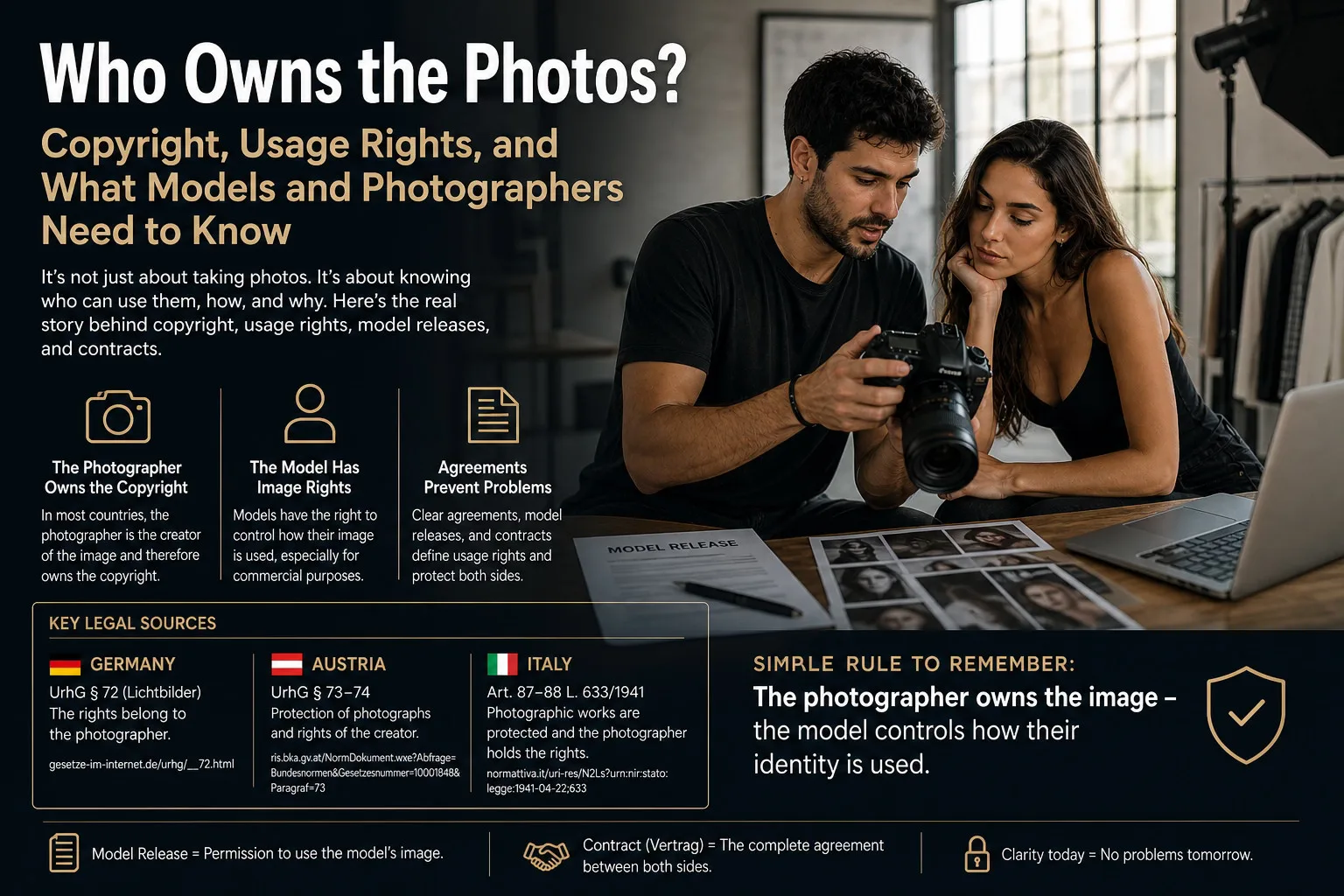
The Photographer Owns the Copyright
There is one thing that is surprisingly consistent across most countries.
The photographer owns the copyright.
Not the model.
Not the client.
Not the person who paid.
The person who created the image.
This is not just industry logic — it is written into law.
For example, in Germany:
- § 72 UrhG (Lichtbilder)
https://www.gesetze-im-internet.de/urhg/__72.html
The law states clearly:
“Das Recht nach Absatz 1 steht dem Lichtbildner zu.”
(The rights belong to the photographer.)
In Austria:
§ 73 Urheberrechtsgesetz
https://www.ris.bka.gv.at/NormDokument.wxe?Abfrage=Bundesnormen&Gesetzesnummer=10001848&Paragraf=73§ 74 Urheberrechtsgesetz
https://www.ris.bka.gv.at/NormDokument.wxe?Abfrage=Bundesnormen&Gesetzesnummer=10001848&Paragraf=74
And in Italy:
Art. 87 Legge sul diritto d’autore
https://www.normattiva.it/uri-res/N2Ls?urn:nir:stato:legge:1941-04-22;633Art. 88 Legge sul diritto d’autore
https://www.normattiva.it/uri-res/N2Ls?urn:nir:stato:legge:1941-04-22;633!vig=
Different countries, same principle:
👉 If you take the photo, you own it.
But the Model Has Rights Too
This is where things become less obvious.
Even if the photographer owns the image, the model is not just “in it.”
A person has the right to control how their image is used.
In Germany and Austria:
- § 22 KUG (Right to one’s own image)
https://www.gesetze-im-internet.de/kunsturhg/__22.html
This law makes one thing clear:
A photo of a person cannot be published without their consent.
So the reality looks like this:
- The photographer owns the photo
- The model controls how their identity is used
Both sides have rights.
And both matter.
Where Most Problems Actually Start
Most issues don’t happen in commercial shoots.
They happen in simple collaborations.
TFP. Quick agreements. Messages like “let’s shoot and see.”
Everything feels relaxed.
Until the images start being used.
A model sends photos to a brand.
A photographer uses them for promotion.
Someone edits something the other person doesn’t like.
And suddenly, there are expectations that were never discussed.
Not because anyone wanted to create a problem.
But because nobody defined anything.
Paying Doesn’t Change Ownership
This is one of the biggest misunderstandings.
“If I pay for the shoot, I own the photos.”
That’s not how it works.
Paying gives you usage rights.
Not ownership.
You are paying for the service, the time, and the result — but the copyright stays with the photographer unless it is explicitly transferred.
And that rarely happens automatically.
What Actually Matters: Usage
The more useful question is not:
“Who owns the photos?”
But:
“What can I do with them?”
That’s where usage rights come in.
For example:
- posting on social media
- using images in a portfolio
- submitting to agencies
- using photos for commercial purposes
These things should be clear before the shoot.
Even a simple agreement makes a difference.
Something like:
“These images can be used by both parties for portfolio and social media, but not for commercial use without additional permission.”
It doesn’t need to be complex.
It just needs to exist.
Model Release and Contracts
This is the part most people ignore — until it becomes important.
A model release is a document where the model gives permission for their image to be used.
Without it, a photographer may own the photo, but cannot legally use it in certain contexts — especially commercially.
Then there are contracts.
These define the full agreement:
- what is being delivered
- how the images can be used
- whether there is payment
- what happens after the shoot
You don’t always need something long or complicated.
But you do need clarity.
Because once images exist, they can be shared, reused, and repurposed very quickly.
And at that point, it’s often too late to go back.
If you want to keep things simple, you can generate ready-to-use agreements here:
👉 https://findashoot.com/en/contracts
The Part People Realize Too Late
Nobody thinks about this at the beginning.
They think about it when something starts to matter.
When a photo gets attention.
When a brand wants to use it.
When there is suddenly money involved.
That’s when unclear agreements become a problem.
Not at the start.
Later.
Final Thoughts
Photography lives between two worlds.
One is creative, intuitive, and emotional.
The other is structured, defined, and legal.
Ignoring one of them doesn’t make it disappear.
It just means you deal with it later.
And usually, later is more complicated.
You don’t need to turn every shoot into a legal process.
But you do need to understand the basics.
Who owns the image.
Who can use it.
And how.
Because the goal is not just to create good work.
It’s to avoid problems once that work starts to matter.
💬 Comments · 0 comments
Be the first to comment.